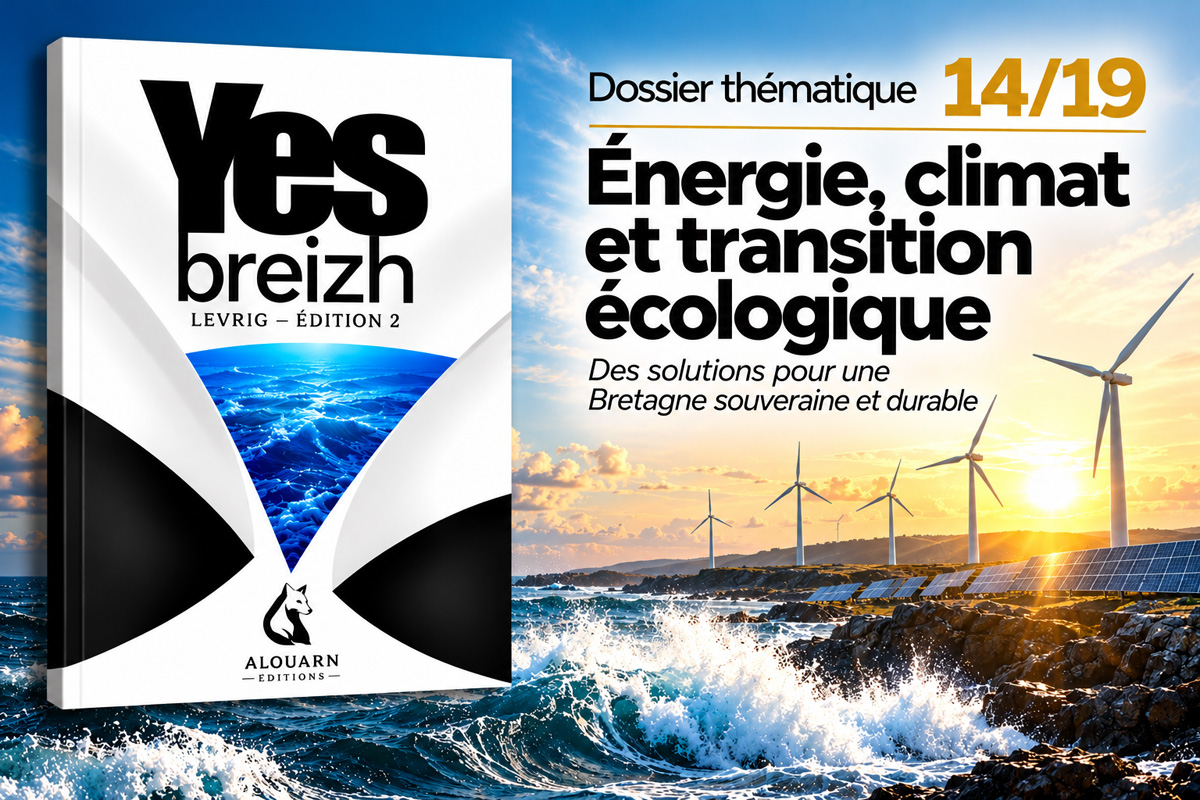
Thematic file 14/19
ENERGY, CLIMATE AND THE ECO-TRANSITION
This text is part of the thematic dossiers of the 2nd edition of Levrig by Yes Breizh.
Protecting, decarbonizing, sharing value
Levrig 2027
Trajectory 2027-2032
NB: «For the sake of fluidity and concision, In this text, the masculine is used to encompass all genders.».
The essentials
For Yes Breizh, the Breton ecological transition must address four vulnerabilities together: energy dependence, still high emissions, degradation of water and biodiversity, increasing exposure to droughts, submersion, flooding and heat. It will only succeed if it reduces bills, creates sustainable jobs and involves the Départements (or countries) in decision-making and revenue generation.
Our goal — First reduce needs, produce more renewable energy within ecological limits
Explicitly, adapting each living space and ensuring that economic benefits remain in Brittany.
A few landmarks
| Documented landmark | Value | Lecture |
|---|---|---|
| Energy production / final consumption | 22 % in 2023 | Administrative region; all energy sources, not just electricity. |
| Electrical supply | About 2/3 imported | Network dependency; does not mean physical scarcity |
| Masses of water in good ecological condition | 34 % | The restoration of water is a central undertaking |
| Green algae strandings | 2,091 hectares, or 93 % of the total national area in 2024 | Beaches and mudflats; strong annual variability |
| VERB perimeter of the Shift Project | >17 % of employment; nearly 2/3 of direct emissions and final energy | Five sectors studied; useful basis for balancing employment-carbon-energy |
The available values mainly relate to the administrative region of four Départements. The 2027 dashboard will have to include the Loire-Atlantique before setting the reference values for Brittany-5.
1. A clear Yes Breizh doctrine: sobriety, security, justice
Do not confuse energy and electricity
Instantaneous electric autonomy is neither total energy autonomy nor network isolation. Public management will distinguish between total final consumption, electricity consumption, local production, installed power, availability, storage, and exchanges. The interconnected network remains a security measure; however, Brittany must reduce its vulnerability and peak loads.
Desirable and physically credible ecology
Physical limits define the scope of the possible; politics distributes effort, time, and benefits. Therefore, choices will be compared on their full cost, their lifecycle emissions, their impact, their effect on water and biodiversity, their resilience, and the jobs created.
A just transition
The Scottish government’s program provides three transposable ideas: a fair transition fund for workers and their counties, support for the ownership of each project, and a patrimonial fund fueled by renewable wealth. Yes Breizh adapts them to Breton law and resources, without taking over the amounts or the objectives of the Scottish program.
2. Governing the whole of Brittany in five departments
| Leverage level | From 2027 onwards | After agreement or devolution |
|---|---|---|
| Powers at the B5 level | Planning, assistance, training, high schools, Breton ports, public procurement, animation and data | — |
| Local contracts | B5, Départements, EPCIs, energy syndicates, Water Agency, network operators | Objectives, co-financing and legally enforceable responsibilities |
| Powers to negotiate | Experiments and contracting with the central government | Energy, taxation, standards, real estate and environmental policing under the future status |
- Creating a Breton Conference1 energy, climate and water, including the Loire-Atlantique region.
- Publish a single annual report: energy, emissions, adaptation, water, biodiversity, jobs and precariousness.
- Transforming BreizhÉnergie into a more capital-intensive investment tool, coordinated with local companies and endowed with measurable objectives.
- Submitting major projects to a public comparison of the variants and to the monitoring of local commitments.
3. Reduce needs and bills
Buildings
For Yes Breizh, it is necessary to move from a logic of isolated actions to efficient renovations accompanied by: audit, financing, works, control and monitoring of consumption. Priority should be given to the homes occupied by modest households, the social housing park, the high schools and public buildings. The regional mission (B4) mentions a scheme aimed at 500 households per year: it must be evaluated and then expanded with the intercommunalities.
Mobility, industry and agriculture
Some proposals from Yes Breizh…
- Reduce the kilometers driven by planning, railways, express coaches, carpooling, and cycling.
- Condition industrial aid on an energy-carbon plan, on heat recovery and on the resilience of supply chains.
- Support farms in reducing input costs, energy efficiency, protein autonomy, and transition incomes.
- Deploying sobriety contracts with objectives, technical assistance and sharing of savings.
4. Produce and secure: a package, not a single technology
| Axis | Proposed decisions | Caution |
|---|---|---|
| Renewable heat | Sustainable wood, solar thermal, geothermal, waste heat and networks | Local resource, air quality, cost per avoided ton |
| Offshore wind power | Ports, industrial chain, training, connectivity and maritime co-use | Biodiversity, fishing, landscape, local contractual benefits |
| Land-based wind & solar | Repowering, roofs, parking lots, and then territorial projects | Avoiding artificialization; local participation |
| Biogas | Priority given to waste, effluents and intermediate crops | Nitrogen balance, soils, methane leaks, no food competition |
| Networks & flexibility | Demand response, storage, management, targeted strengthening | Cybersecurity, full cost, data protection |
| Emerging marine energies | Demonstrators and R&D with exit criteria | No industrial promise before technical and economic proof |
As a methodological precaution, the offshore wind farm in Saint-Brieuc (496 MW) is sometimes presented as covering 25 % of the needs: this proportion refers to domestic electricity consumption, not to total electricity consumption or total energy.
5. Share values and prepare skills
Some proposals from Yes Breizh…
- Creating a Breton Transition Fund 2 just for the reconversion, the training and the exposed departments (or countries).
- Allocate an investment capacity to the communities and Breton women and men in the publicly supported projects.
- Negotiate a local profit base: jobs, training, territorial funds, biodiversity and solidarity tariffs when the law allows it.
- Study a Breton Generation Fund, funded by a stable fraction of exceptional public revenues linked to renewable resources.
- Publish the jobs created, transformed or weakened, as well as the quality of contracts and training needs.
6. Water, biodiversity and green algae: a requirement of result
Yes breizh has taken note of a report from the Court of Auditors that reducing nitrate concentrations and flows is the only leverage that can significantly limit outbreaks. In 2024, concentrations remained above 25 mg/l in several sectors, while the necessary thresholds vary depending on the bay.
| Action | Deadline | Proof of result |
|---|---|---|
| Modeling each priority bay and mudflat | 2027 | Local threshold compatible with a division by two of the green algae strandings |
| Reviewing SAGE3 and territorial agreements | 2027-2028 | Measurable nitrogen targets, designated lead and funding identified |
| Conditioning public aid | From 2027 onwards | Progressive contracts and control of nitrogen leaks |
| Mobilizing land and resources | 2028-2032 | Surfaces and farms engaged in low-input systems |
| Securing the collection and information | Every season | Timelines, exposure of agents and published incidents |
7. How, according to Yes Breizh, to adapt Brittany to the coming climate
- By 2028, map the risks of heat, drought, fire, flooding, erosion, and basin submergence.
- Condition public investments on a climate test in 2050 and 2100.
- Re-naturalizing cities, waterways and wetlands; removing impermeable soil surfaces and protecting ecological continuity.
- Adopting water-sharing plans that prioritize drinking water and ecosystems, then essential uses.
- Create an adaptation fund for rural, coastal and island communes, with shared engineering.
Principle — No expenditure on adaptation should be used to maintain an installation that has become dangerous indefinitely. Withdrawal, relocation and solidarity must be able to be discussed openly.
8. Fifteen commitments 2027-2032
1. Building the Brittany-5 energy-climate-water balance.
2. Vote on sectoral carbon budgets that are indicative and then enforceable depending on the competencies.
3. Prioritize renovating precarious housing and public buildings.
4. Organizing the reduction of forced mobility.
5. Decarbonizing industry and the agro-food sector with conditions in return.
6. Developing renewable heat.
7. Planning wind, solar and marine energy with ecological limits.
8. Strengthening networks, storage and flexibility.
9. Redefining the Pôle Energie Bretagne (PEBreizh) as a territorial investor.
10. Create the Just Transition Fund.
11. Open up projects to local investment.
12. Studying a patrimonial fund for future generations.
13. Setting targets per bay for green algae.
14. Deploying adaptation plans by living area.
15. To report annually to the Assembly and to the Breton women and men.
Conditions of implementation
No transformation is generalized without a budget, a market opportunity, revenue and evaluation. No objective is imposed without a budget, a timeline, support, and accessible technical solution. No transfer takes place without resources. In the event of failure, the system is corrected rather than maintained for appearances’ sake. A code green, orange, red It will indicate the trajectory, but will never replace the figures and their explanation. A temporary increase in an indicator may correspond to a transition or to a better census: each evolution will be interpreted before a decision is made.
9. Calendar 2027-2032
| Year | Priorities | Public platform |
|---|---|---|
| 2027 — Measuring | Brittany-5 assessment; governance; carbon budgets; audit of BreizhÉnergie; bays and mudflats | References, areas of responsibility and published persons |
| 2028 — Contracting | Local contracts (Departments) water-energy-climate; renovation; just funds; adaptation maps | 100 % from Brittany covered by a roadmap |
| 2029 — Invest | Warmth, networks, ports, flexibility, renovation and rewilding; participation of Breton women and men. | Independent review of costs and impacts |
| 2030 — Correct | Mid-term review; reallocation towards effective measures; exit clauses | Explanations of deviations from the trajectories and corrective measures voted on |
| 2031 — Extend | Generalization of proven mechanisms; competencies assigned if agreed upon | Continuity of certified services and funding |
| 2032 — Evaluate | Environmental, social, economic and territorial impact; next program | External evaluation and democratic debate Brittany-5 |
The final quantified targets will be set after the Brittany-5 review in 2027. The timetable distinguishes between actions that are immediately feasible from those that require national agreement or devolution.
10. Monitoring dashboard
| Indicator | Reference/target | Frequency | Pilot |
|---|---|---|---|
| Final energy consumption | 2027 Brittany-5; annual decrease compatible with 2032 trajectory | Annually | Observatory |
| Territorial emissions and footprint | Sectoral budgets; two published readings | Annually | Observatory |
| Local production / consumption | 22 % in 2023 on B4; reference B5 in 2027 | Annually | Brittany |
| Part of imported electricity | About 2/3 on B4; reducing vulnerability, without self-sufficiency | Annually | RTE / Brittany |
| Efficient renovations | Number, real gain and modest households; target 2032 after audit | Semiannual | Brittany / EPCI |
| Energy vulnerability | Household rates and remaining burden | Annually | Social Observatory |
| Renewable heat | TWh, power and emissions avoided | Annually | Energy unions |
| Projects with local participation | Share of projects and local capital held | Annually | Pôle Bretagne Energiee |
| Transition jobs | Created, transformed, quality and training | Annually | Brittany |
| Masses of water in good condition | 34 %; progression by basin | Annual cycle | Water Agency |
| Nitrates per bay / pond | mg/l and flux; scientific local threshold | Monthly / annual | SAGE |
| Green algae strandings | 2,091 ha in 2024; multi-year trend | Seasonal | CEVA4 / Central state |
| Artificialization / Renaturation | hectares used, restored and made permeable again | Annually | Locally |
| Population covered by adaptation plans | 100 % in 2028 | Annually | Climate conference |
| Investments tested in the climate | 100 % of the major projects in 2029 | Budget | Brittany |
| Local benefits of RE | € paid out, projects, beneficiaries and uses | Annually | Independent authority |
11. Risks and precautions
| Risk | Safeguard |
|---|---|
| Goals without means | Budget, responsibility, deadline and indicator for each commitment |
| Confusion of the boundaries | Year, unit and local granulometric reference indicated for each figure |
| Reduced acceptability to discourse | Choice of variants, capital sharing and local profits enforceable |
| Conflicts between climate and biodiversity | Cumulative evaluation, avoidance before compensation |
| Socially regressive transition | Targeting of aid, co-payment and distributive monitoring |
| Centralization in Rennes or Nantes | Living-space contracts and local engineering |
| Dependence on technology | Diversified portfolio and review clauses |
Conclusion
For Yes Breizh, Brittany will not progress through self-sufficiency or passivity. It will progress by consuming less and better, producing more in harmony with the living world, preparing for risks, and retaining a share of the value created locally. The democratic rule of law must be the benchmark: every commitment must have a responsible person, funding, a deadline, and evidence of results.
Mobilized resources and precautions
- Brittany Region, Mission booklet 6 — Energy transition, biodiversity, water and waste, budget 2026.
- Observatory of the Environment in Brittany, Key figures on energy and greenhouse gases in Brittany, edition 2025.
- Regional Accounts Chamber of Brittany, 2026 summaries on renewable energy and BreizhÉnergie.
- Court of Auditors, Fight against the proliferation of green algae in Brittany, synthesis, July 2026.
- The Shift Project, Towards a low-carbon regional economy in Brittany (VERB), document submitted.
- SNP, Government Programme 2026: just transition, community ownership, patrimonial funds, adaptation.
- Documents submitted for discussion: Brittany and sustainable development; Electricity in Brittany: the truth and the lies; correspondences and notes by Prébay–Jancovici–De Gélis.
The proposals constitute a synthesis of the work, not an exhaustive recapitulation of the sources. The data will have to be updated with each publication of Levrig. The figures for the four départements are not mechanically extrapolated to the Loire-Atlantique.
Notes and clarifications
1. Any creation of an observatory or agency etc. will have to be linked to the disappearance of at least one other equivalent public entity with the full reinstatement of the staff. Adjustments may be made subsequently. ↩
2. See previous note. ↩
3. Water Management Planning Scheme ↩
4. Centre for the Study and Valorization of Algae ↩
The thematic dossiers of Levrig 2027 by Yes Breizh
• 1. Statute, institutions, devolution and Constitution
• 2. Public finances, budget and fiscal autonomy
• 2 bis. Budgetary analysis France – Brittany 5
• 3. The public service in Brittany
• 4. Health in Brittany
• 5. Disability in Brittany
• 6. Education, training and higher education
• 7. Culture, languages and media
• 8. Breton identity, transmission and cohesion
• 9. Housing in Brittany
• 10. Employment, businesses and economic development
• 11. Economy, trade and mobility
• 12. Agriculture and food
• 13. Sea, coast and fishing
• 14. Energy, climate and the ecological transition
• 15. Digitalization and sovereignty
• 16. Security, justice and defense
• 17. Europe and internationally
• 18. Breton Diaspora and international outreach