
Voics of Brittany is a series of short interviews offered by Yes Breizh.
Through five simple questions, Breton women and men from different backgrounds share their vision for the future of Brittany.
Their answers are published as they are, without modification.
Who is Pêr Vari Kervarec?
Peter Mark Kervarec and the future of Brittany.
Artist, singer and musician, Peter Mark Kervarec is part of a process deeply rooted in Breton culture.
Through music and encounters, he explores the links between transmission, identity and modernity.
His journey, enriched by human and cultural experiences, questions Brittany's place in today's world.
Pêr Vari Kervarec shares his views on the future of Brittany in this interview.

What about your personal journey led you to commit to Brittany today?
I wouldn't say there was a specific moment. It's something that built up gradually.
In the beginning, there were my grandparents. They were farmers, from a rural background. For them, Brittany wasn't a speech or a commitment. It was a way of life. A connection to the land, to work, to others.
They didn't necessarily talk about it. But they simply brought it to life.
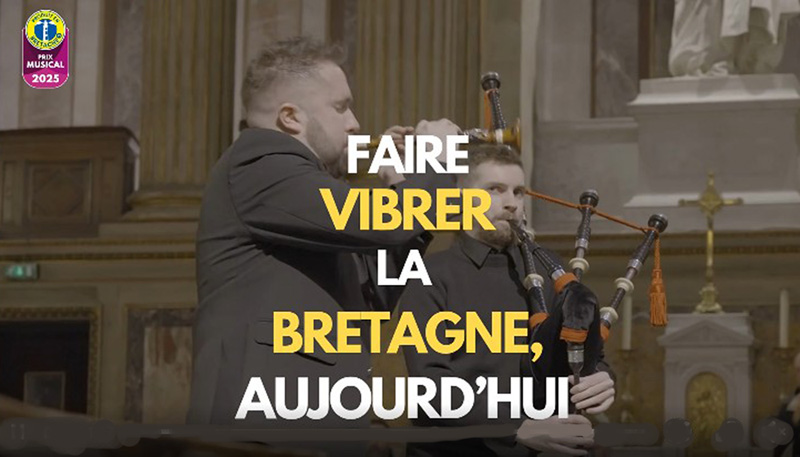
And then, very early on, there was music. I started the bombard at ten years old, at the Quimper conservatory and at the Bagad Bro Foën.
And there's a person who meant a great deal to me: my teacher, Jean-Yves Herlédan.
He didn't just teach me an instrument. He passed on something deeper to me. The desire to sing about Brittany and to know its history. To understand what I was doing. To give meaning to every note.
It was then that things began to take on a different dimension.
Then, over time, I met a lot of people. Very different people, but who all had in common this connection to Brittany. Some spoke Breton, others didn't. But all, in a way, spoke Brittany. In their gestures, in their gaze, in their way of being.
These meetings left their mark on me because they were sincere, profound, and unpretentious.
And bit by bit, I became aware that all of this could disappear. That, concerning language, culture, memory... nothing was guaranteed.
That's where I understood the importance of knowing our past.
Because we cannot move forward without knowing where we come from.
To know the history of Brittany is not to look backwards.
It's about understanding. It's about finding your footing. But you also have to live in the present.
To keep this culture alive today, in the world as it is. And from there, to be able to think about the future. My commitment came about like that.
Not against something, but to convey, to ensure that this link is not lost. And also with this desire to make Brittany travel. To make it known elsewhere. To show that it is alive, that it has something to say to the world. Not as a closed identity, but as an open culture, capable of dialogue, of sharing.
And all of that is also a way to honour my grandparents, my ancestors, and all the people I've met along the way.
Because deep down, they taught me one simple thing: We do not just speak a language. We carry a world.
And as long as we know our past, live our present, build the future, and dare to share it with others, then Brittany continues to exist.
In your opinion, what is the main obstacle today that prevents Brittany from truly deciding for itself?
I think the main blockage today isn't just political. It's deeper than that. It touches how we think. France has been built on a very strong idea of unity, sometimes at the expense of diversity.
For a long time, local cultures were seen as something to fit into a common framework, rather than as a wealth to be valued.
And in this context, Brittany, like other territories, has often been sidelined. But we also need to be concrete.
We are in a highly centralised system, where many decisions are still made in Paris, even on very concrete issues that affect daily life in Brittany. And that creates a simple problem: local elected officials are chosen by citizens, with a plan, but they don’t always have the means to implement it. There is a real disconnect between responsibility… and power.
Today, for example, local authorities have very little fiscal autonomy. They depend heavily on decisions made at the national level.
So Elected officials are being asked to act… without really giving them the levers.
It's the same for the rules: it's very difficult to adapt policies to local realities. Whether it's for transport, agriculture or housing, we have to go through national law. When decisions could be made here, closer to the ground, more effectively. But beyond institutions, there's also something more internal.
For a long time, the idea was integrated that decisions came from on high. That legitimacy lay elsewhere. And that still hinders taking initiative today.
There is also confusion in the debate.
Autonomy and independence are often confused.
While autonomy isn't about leaving France. It's simply about organising the country better, by giving more responsibility to the regions.
And that's what most European countries do.
There is also a French difficulty in fully recognising the diversity of territories and identities.
For my part, I feel deeply Breton, part of a French reality, and open to Europe and the world.
These affiliations do not oppose each other; they are complementary. And recognising that would strengthen the whole. But we also need to be clear-sighted about ourselves.
Today, there are two attitudes.
There are those who observe, who criticise, who complain... but who don't necessarily propose solutions.
And then there are those who get involved. Who take concrete action, on the ground. Who bring culture to life, who create, who propose, who build.
And that's where things progress. Because change won't just come from the top. It will also come from this local energy.
So fundamentally, the blockage is manifold: it is institutional, cultural... but also mental.
It is a matter of trust, of legitimacy.
Because deciding for yourself is not just a matter of power. It is also a matter of mindset.
And I think we're arriving at a pivotal moment today. Mentalities are changing. Society is ready and examples exist elsewhere.
The real question is no longer: « Can we? »
But: « Shall we dare? »
When you look at the Yes Breizh initiative, what strikes you as different or useful compared to what already exists in Brittany?
What strikes me as different with Yes Breizh, it's first and foremost the way of approaching things.
We're coming out of a debate that, for a long time, was a bit stuck between autonomy and independence. Two words that, fundamentally, sometimes prevented us from talking about the concrete.
There, with devolution, we speak of processes, stages and reality.
People are not asked to choose an abstract model.
They are invited to consider a simple question: What do we want to decide for ourselves, here, in Brittany?
And that changes a lot of things.
What I also find important is that it's not a party. It's a movement.
That means it's for everyone. Not just for people who are already convinced, but also for those who are asking questions, who doubt, who are seeking to understand.
There is a desire to explain, to take time, to make these subjects accessible.
And that's essential.
Because, ultimately, these are questions that concern everyday life: Health, agriculture, housing, culture. It's not theory.
And then there's something which I find fair in this approach: You can't force things.. You don't tell people where to go.
Let's move forward, step by step, and decide together.
It's a democratic approach.
Finally, what speaks to me is that Yes Breizh puts citizens at the centre.
We do not speak for them. We do not decide for them. We give them a voice in the debate again.
And today, I think that's what's missing the most: regaining collective confidence.
Deep down, Yes Breizh It may not provide a ready-made answer. But it opens a space for reflection, for debate, for building.
And in the current context, that space... it is necessary.
If Brittany had more responsibilities and decision-making powers, what concrete changes would that bring to the daily lives of Bretons?
I think that would change a lot of things… but especially in a very concrete way.
We often talk about institutions, skills, powers... but ultimately, what matters is daily life.
If Brittany had more levers, we could first decide more quickly.
And above all, to make better decisions, because decisions would be made here, based on the realities on the ground.
Let's talk about health.
Today, decisions are often thought of on a national scale, with a global logic. But the needs are not the same everywhere.
Here, we could organise hospitals differently, anticipate medical deserts, and adapt prevention policies.

Same for the housing.
Tensions are known, particularly on the coast.
With more power, we could better regulate and protect access to housing for residents.
On transport too, There's a lot to do. Better to connect the territories, develop railways, adapt solutions to real-world uses.
In agriculture, it is essential. We could work directly with farmers to build a model that is both productive and more environmentally friendly, starting from the ground up.
But for me, there's a central point: culture, history, and languages.
Today, all of this exists, but often remains fragile. With more responsibilities, we could genuinely give them a place.
Develop the teaching of Breton and Gallo. Make them live in society, not just in limited frameworks.
To better pass on the story of Brittany too.
Not to oppose, but to understand.
Because knowing where you come from gives you purpose.
And beyond all that, there is something deeper.
Today, many people feel that decisions are made elsewhere. That it doesn't really depend on them.
If things are decided here, it changes the relationship with politics. It re-establishes connection. It restores responsibility.
Because deciding locally means taking responsibility for one's choices. We can no longer pass the buck.
Ultimately, what this would change isn't just public policy. It's a way of living together.
Closer. More concrete. And perhaps more accurate.
To those who are still hesitant to take an interest in Brittany's collective future, what would you like to say?
I would first tell them that there's no need to be a specialist, or already involved, to be interested in it.
Taking an interest in the future of Brittany is not getting involved in something complicated or insular.
It's simply starting to ask questions about what's around us.
How do we live here?
What do we want to keep?
What do we want to convey?
Because at the end of the day, that's what it's about. Not adhering to a ready-made idea, but taking part.
The question is simple: Do we want to remain spectators... or become actors ?
A performer, each in their own way.
By gathering information, by exchanging views, by taking an interest in what makes up our daily lives.
But also by listening. Listening to a language, music, a story.
Because Brittany isn't just a territory. It's a sensibility, a memory, a way of being in the world.
And that part, if we don't keep it alive, if we don't pass it on, it gradually fades away.
For me, being an activist isn't about opposing. It's about loving enough to pass on.
To pass on a living Brittany to future generations.
A Brittany that continues to create, to speak, to sing.
But also an open Brittany.
Because being rooted here doesn't stop you from looking elsewhere.
On the contrary.
A strong culture is one that engages in dialogue, shares, and interacts with others.
So I would simply tell them: Start by listening.
And perhaps through this, the desire to understand will arise, then to get involved, each in their own way.
Because ultimately, the future of Brittany doesn't depend on a speech. It depends on those who choose, one day, to take part in it.
———————–
Through this interview, Peter Mark Kervarec offers a personal insight into the future of Brittany and the transmission of its culture.
Yes Breizh thank you warmly Peter Mark Kervarec for the time allowed and the quality of their answers.
Find the other interviews from our Voices of Brittany series at Yes Breizh:
– Yvan Moullec, Mayor of Plouhinec, Finistère.
– Samuel Le Port, CEO Messaging Treebal
– Ondine Morin, Professional fisherwoman in Ouessant
Join Yes Breizh.
Join one of our local groups.
Create or integrate a Think Tank.
Support Yes Breizh with a donation.