

Voics of Brittany is a series of short interviews offered by Yes Breizh.
Through five simple questions, Breton women and men from different backgrounds share their vision for the future of Brittany.
Their answers are published as they are, without modification.
Ondine Morin is a French actress.
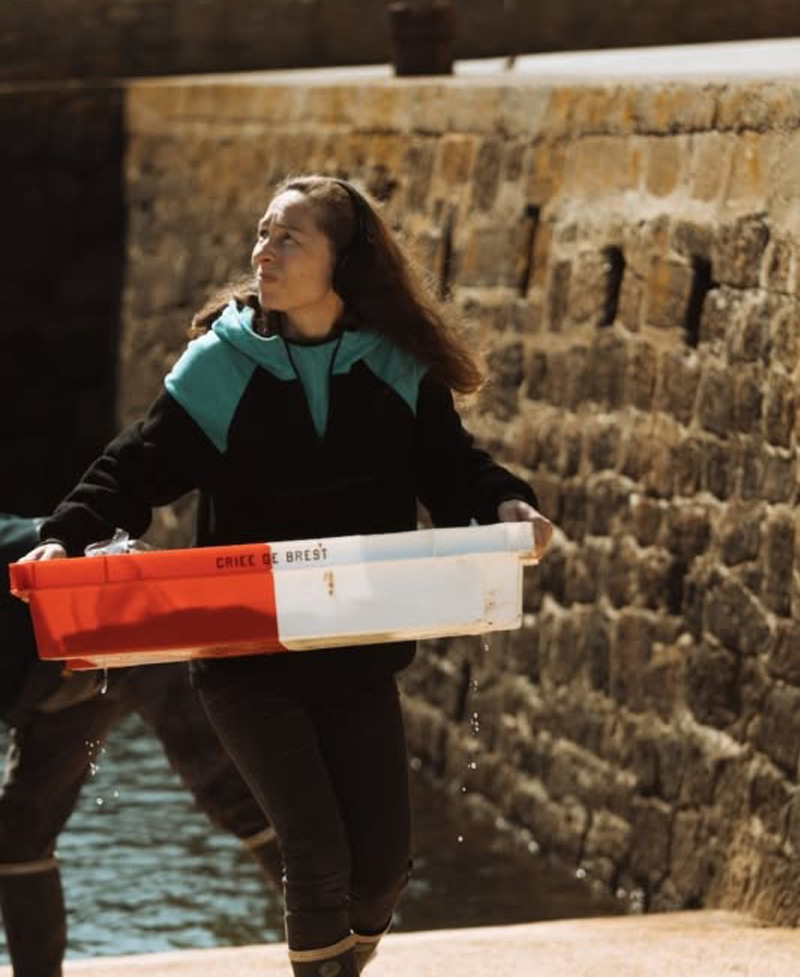
Ondine Morin is a professional fisherwoman, a guide-lecturer, and deeply attached to Ushant where she lives all year round.
Through its line fishing activity and its commitment within Kalon Eusa, it introduces visitors to the history, legends, and exceptional heritage of this island located at the western tip of Brittany.
Passionate about the sea and about sharing knowledge, she advocates for an approach that respects living things, convinced that the inhabitants of a place are best placed to preserve it. Her perspective, shaped by island life, blends a love of nature, a sense of responsibility, and a desire to pass on a heritage that is as rich as it is fragile to future generations.
In this new interview with Voice of Brittany, Ondine Morin shares her vision for the future of the Breton islands, coastal preservation, and a responsible commitment to serving Brittany.

Living and working on Ouessant, is this another way of looking at Brittany and its future?
To live and work all year round on Ouessant stems from a passion for this island.
It is above all for this gentle pace of life on a daily basis that I stayed in Ouessant,
And to share it with my children, as I had the happiest and most privileged childhood here.
We're trying to keep the connection with Brittany alive, by introducing it to our children, even if my eldest son, at six and a half years old, « I find nothing more beautiful than Ouessant« .
Ouessant allows them to dream because one can still imagine a bright and hopeful future there.
Through your profession as a fisherwoman and your involvement with Kalon Eusa, what do you most want to convey to those discovering your island?
I naturally pass on my passion for Ouessant.
Sometimes I don't quite realise it myself, but when I see the look of dreams in the children's eyes after a walk on the island legends, or the starry-eyed look of the adults after enjoying the lighting of the Iroise lighthouses, I feel fulfilled.
I appreciate selling the fruit of my fishing to knowledgeable people, in the sense that they understand where and how the fish was caught.
Otherwise, I'll take the time to explain it to them.
The loveliest compliment I've ever received: "I love your fish because it has a soul." For almost every fish I catch, I could tell you an anecdote about how it bit, where it happened, and how we brought it on board.
In your opinion, what are the main challenges facing the Breton islands today, and more broadly, the Breton maritime world?
I think the main challenge for future generations (and starting today) is the «preservation of Nature».
The first inhabitants, dating back to the Mesolithic period, «bequeathed» us their island by respecting and preserving it, and we have a duty to protect and safeguard it. The watchword will be respect for the Living and the Mineral, and the humility of the people who inhabit it. The elements will always have the final say; we are only passing through, but we can all act to protect it for future generations.
If Brittany had more responsibility for managing its coastline, its sea, and its heritage, what concrete changes do you think that would bring?
The region, but above all local associations, should carry more weight in decisions taken, for example, at the European level, which are completely beyond us, or even have nothing to do with our territory.
Thus, each local authority could choose its priorities thanks to local associations which know the area perfectly and have had decades of perspective.
For the sea, we should trust associations like the one I'm part of. The Liners of Pointe Bretagne composed of passionate line fishermen who know their fishing grounds better than anyone and who would be quite willing to manage them.
Often, the state legislates years after decisions have been made at the association level (for example, the biological resting period for sea bass). It is time today to listen to them and act quickly; this is crucial for the fish stocks off the Breton coast.
What message would you like to send to the women and men of Brittany who wish to preserve what makes their country rich while preparing it for the challenges of tomorrow?
We must act now, form associations and never give up.
Through this interview, Ondine Morin invites us to look at Brittany with a different perspective, from Ouessant, where the sea, nature and transmission shape the daily lives of its inhabitants.
Yes Breizh warmly thanks Ondine Morin for the time granted and the sincerity of her answers.
Photos Ondine Morin
Find Ondine on Kalon Eusa.
Find the other interviews from our Voices of Brittany series at Yes Breizh:
– Yvan Moullec, Mayor of Plouhinec, Finistère.
– Samuel Le Port, CEO Messaging Treebal
– Peter-Vari Kervarec, musician.
Join Yes Breizh.
Join one of our local groups.
Create or integrate a Think Tank.
Support Yes Breizh with a donation.