What is devolution?
La situation politique en France met chacun de nous en danger, que ce soit sur les plans économiques, environnementaux, culturels ou sociaux. Yes Breizh, un mouvement et non un parti politique, appelle chacune et chacun en Bretagne à soutenir un processus de dévolution des pouvoirs à la Bretagne.
Devolution is more than just a word; it is a process that will have a major impact on the future of Brittany.
But what else?
Depuis plusieurs décennies, le débat sur l’avenir institutionnel de la Bretagne tourne souvent autour de deux termes : autonomie et indépendance. L’un paraît trop galvaudé, l’autre trop clivant. Yes Breizh propose de leur préférer un mot qui rassemble, un mot qui ouvre une perspective réaliste et constructive : la dévolution. Ce terme, emprunté à l’expérience britannique, désigne le transfert de pouvoirs d’un État central vers une nation ou une région. Pour la Bretagne, il s’agit de construire une capacité réelle à décider de son avenir, dans un cadre démocratique, clair et apaisé, sans tomber dans des débats piégés.
Origin and meaning of the word «devolution»
The word devolution comes from the Latin devolvere, In French law, devolution refers to the transfer of a right or charge, as in succession or inheritance. In French law, devolution refers to the transfer of a right or charge, as in succession or inheritance. Applied to politics, it takes on a broader meaning: the transfer of powers from central government to a local or national authority. It is not a sudden break, but a gradual, negotiated process. It is this meaning that came to the fore in the United Kingdom at the end of the XXᵉ century.
The British model
In 1997, the United Kingdom undertook a major constitutional reform: the devolution of power. It has given Scotland, Wales and Northern Ireland extensive powers in areas such as health, education, agriculture, culture and the economy.
- Scotland : creation of the Scottish Parliament and a government in Edinburgh. The Scots now have very extensive powers, including fiscal powers.
- Wales : Establishment of the Senedd (Welsh Parliament) and a government in Cardiff, whose powers were extended over time.
- Northern Ireland : a more complex system, based on the sharing of power between communities, but also illustrating the logic of devolution.
An assessment after more than 25 years: la dévolution a permis à ces nations de renforcer leur démocratie, d’adapter leurs politiques publiques à leurs réalités et de donner une visibilité institutionnelle à leur identité nationale. Certes, des tensions existent, notamment en Écosse avec la question de l’indépendance, mais le Royaume-Uni n’a pas explosé pour autant.
Devolution, autonomy, independence: clarifying the terms
To avoid confusion, it is essential to distinguish between three concepts:
- Autonomy : greater, but limited, local power, which remains dependent on the central state.
- Independence : full sovereignty, the creation of a separate state with its own diplomacy, army and currency.
- Devolution : a gradual, step-by-step process that transfers specific skills to a nation.
Elle peut mener à une autonomie très large, voire à l’indépendance si le peuple le décide, mais elle n’impose pas de choisir à l’avance. C’est pour cette raison que Yes Breizh préfère ce mot : il est clair, pragmatique, rassembleur et porteur d’avenir.
Why devolution for Brittany?
Brittany has been under the weight of French centralism for centuries. Its institutions were abolished in 1789, its voice reduced to that of a mere «region», and its resources often controlled from Paris. The result: political under-representation, ridiculously low budgets, lagging infrastructure and a persistent disregard for its culture and language. Yet Brittany has many assets: a young, skilled population, an economy open to the world, and a strong, inclusive culture. Devolution would enable Brittany to regain control of its decisions, manage its priorities and invest according to its real needs.
Key areas for devolution in Brittany
- Health and social work : hospital organisation, prevention policy, support for carers.
- Education and culture : adapted programmes, promotion of Breton and Gallo, artistic and scientific development, teaching the History of Brittany.
- Economy and taxation : tax collection in Brittany for Brittany, support for SMEs, innovation strategy.
- Energy and the environment : steering offshore wind farms, energy transition, coastal protection and sustainable development.
- Agriculture and fisheries : adapting European policies to the realities of Brittany.
- Housing and development : combating speculation, regulating second homes and investing in social housing.
- Transport and infrastructure : modernisation of the rail network, interconnections between cities, ports and airports.
- Political representation : creation of an Assembly of Brittany and an executive accountable to the citizens.
Obstacles and objections
Too small... in terms of surface area?
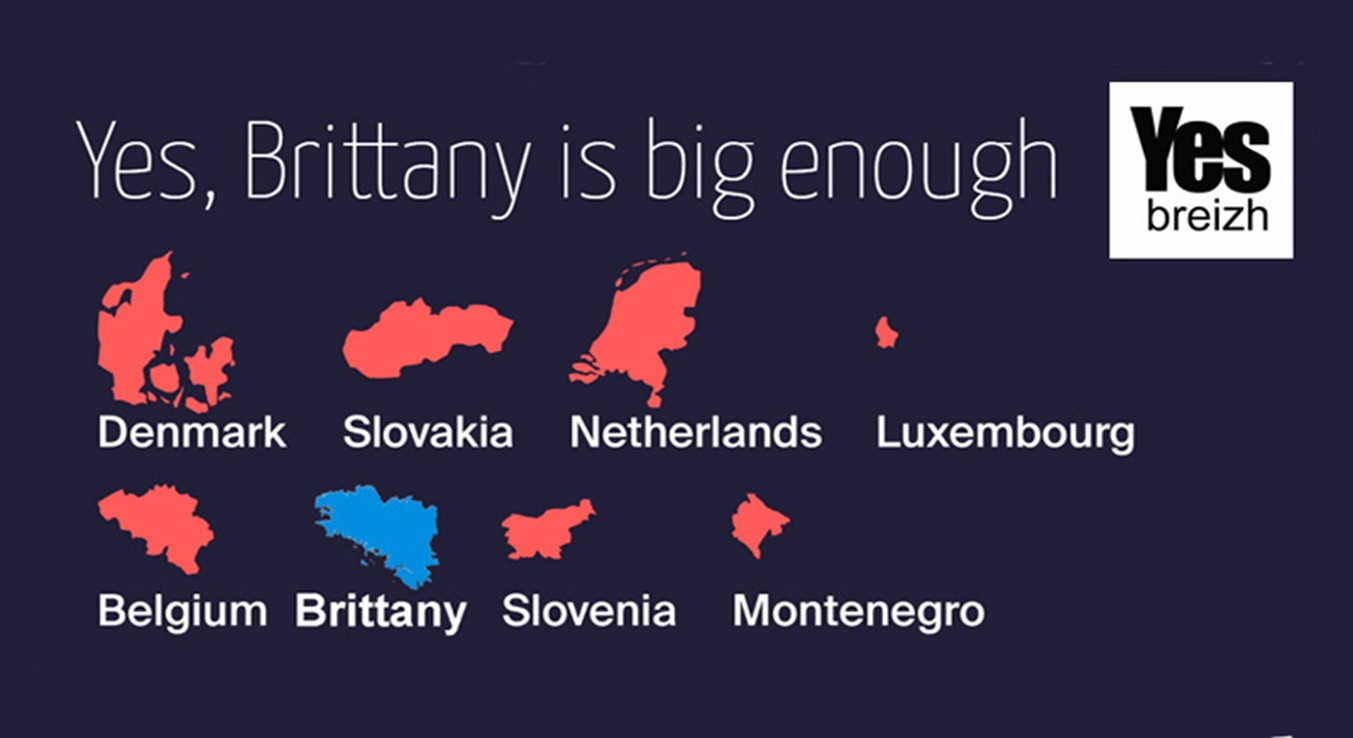
At 34,000 km², Brittany is larger than Belgium (30,688 km²), Slovenia (20,273 km²) and only slightly smaller than the Netherlands (41,543 km²). Many prosperous states are smaller.
Too small in terms of population?
Brittany has a population of nearly 5 million, as many as Slovakia, Ireland or New Zealand, and many more than Croatia, Slovenia or the Baltic States. These nations are independent and viable, some of them members of the EU. It would never occur to anyone to question their status.
The German Länder model
The comparison is even more striking in Germany. Länder such as Saarland (population 990,000) and Bremen (population 680,000) have parliaments, governments and extensive powers. Brittany, with its 5 million inhabitants, therefore has greater legitimacy than several German Länder.
👉 So Brittany is neither too small nor too poor.
It has simply been deprived of its levers for action.
A democratic and progressive process
Devolution can only take place if the people of Brittany so wish. This presupposes an open debate, followed by a democratic vote, such as a referendum. This is the ambition of Yes Breizh.
A realistic timetable could be set for 2032, with clear milestones:
- Opening of a public and media debate.
- Consultative referendum in Brittany.
- Constitutional review in France.
- Elections for an Assembly of Brittany and installation of a responsible executive.
This gradual process will help to avoid sudden breaks and build a new relationship of trust between Brittany and France.
Published in English by Nation Cymru
Devolution and a shared future
Devolution does not imply a break with central government. It allows links to be redefined on an equitable and respectful basis. Paris would retain certain sovereign powers (diplomacy, army, currency), while Brittany would manage the bulk of social and economic issues.
At the same time, Brittany could strengthen its position in Europe and the world: direct relations with Ireland, Scotland and Wales, opening up to the Atlantic and the Celtic Sea, active participation in European regional networks.
Devolution: a word, a project, a new-found confidence
La dévolution n’est pas un slogan. C’est un outil politique éprouvé, qui a déjà fait ses preuves ailleurs. Pour la Bretagne, elle représente une chance historique : celle de reprendre la main sur son destin, de construire une société plus juste et plus efficace, et de donner confiance aux générations futures. Ni autonomie floue, ni indépendance immédiate : la dévolution trace une voie claire, démocratique et progressive. Une voie qui permet à la Bretagne d’être enfin maîtresse de son avenir, tout en restant ouverte au reste du monde.
C’est l’ambition de Yes Breizh.
Beyond the current political divisions, which are completely outdated.
To support Yes Breizh : HelloAsso
To support Yes Breizh : PayPal
To join Yes Breizh : Yes Breizh membership