Yes Breizh interview: Yvan Moullec «Towards a Republic of Territories?»
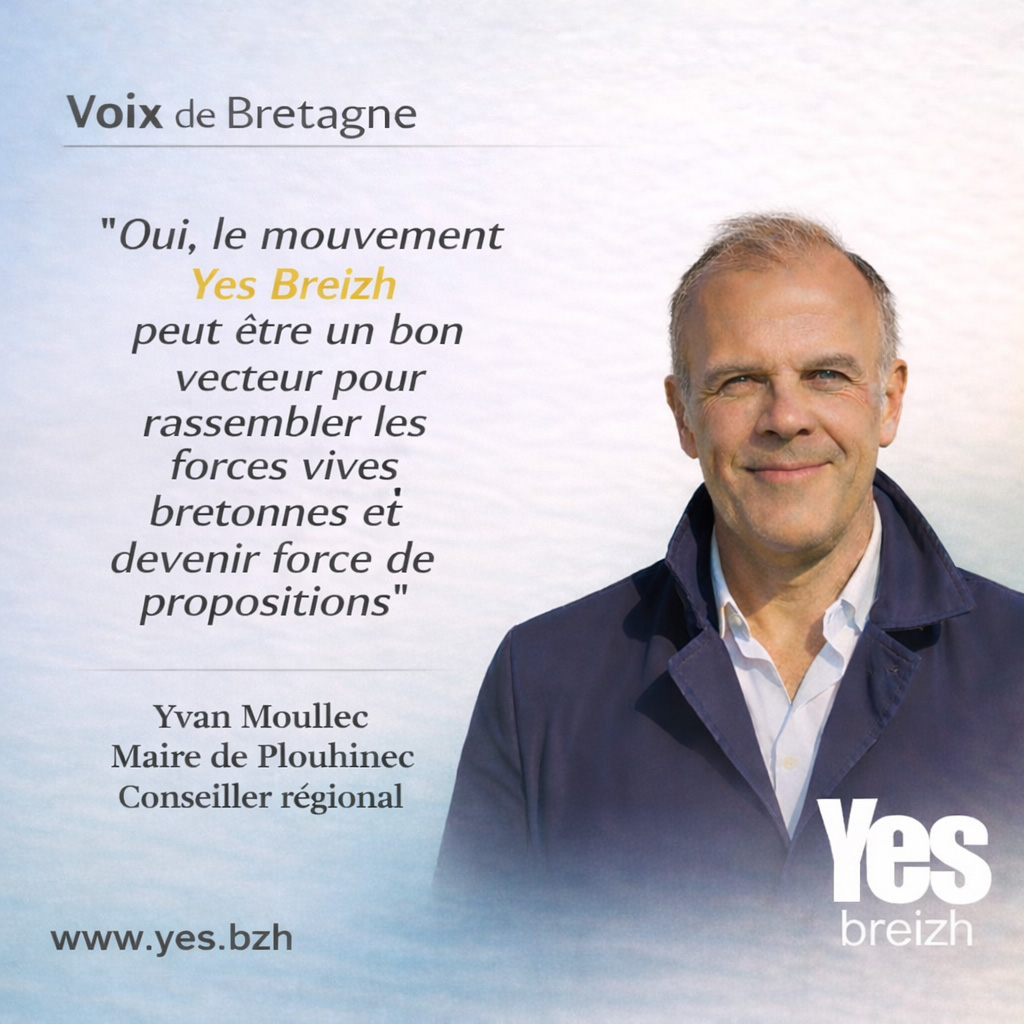
As part of its commitment to dialogue and openness, Yes Breizh regularly gives the floor to those who believe that Brittany should take greater responsibility for its future. We met up with Yvan Moullec, mayor of Plouhinec and regional councillor, author of a remarkable appeal entitled «Pour une République des territoires» ("For a Republic of Territories"). In this article, published in Le Télégramme on 11 October, he invited Breton elected representatives to look beyond partisan divisions and work together to build a new democratic model based on proximity, trust and responsibility. In many ways, this vision is in line with the thinking behind Yes Breizh, a Breton movement inspired by the Welsh Yes Cymru model, which is working to give the whole of Brittany a voice and the power to act.
Your call for a “Republic of Territories” resonates strongly with our approach at Yes Breizh. When you use this expression, are you talking about a simple reinforced decentralisation, or a real change of model where the regions finally become masters of their own choices?
I'm talking about a genuine statute of autonomy, often taking the example of Spain and in particular the autonomous regions of Catalonia and the Basque Country, but the examples of Wales and Scotland are also a source of inspiration. As I see it, the only thing that remains within the remit of the State is sovereignty.
You say that the Jacobin model has reached its limits. In concrete terms, how is this centralism currently hampering the ability of elected representatives and local players in Brittany to take action?
French-style centralism, which is unique in Europe, has always endeavoured to achieve total uniformity across the country, without taking into account the differences and singularities of the various regions that make it up. It therefore centralises almost all powers, and therefore almost all financial resources, not to mention the over-administration that stifles and kills any desire to do things differently. In this context, the capacity for action of elected representatives, and I'm thinking in particular of the Regional Council, is impossible. With a meagre budget and reduced powers, the damage is done. In this country, we have, in particular, senior civil servants fed on the ENA diet, who have a vision of the country that doesn't go beyond the outskirts of Paris, and who do everything they can to keep control of a system that doesn't work, but which they manage, rather than envisage another form of governance, based on the autonomy of the regions, but over which they would no longer have control.
You describe a Brittany that is “ready” to take on more responsibilities. In your opinion, what are the three areas of responsibility, or more if you wish, that Brittany should manage directly to better meet the needs of its inhabitants?
In my mind, we are transferring all competences, with the exception of sovereignty, to the regions that so wish. I'm convinced that Brittany can be a pioneer in this area, following the Spanish model, with a phased approach over time.
You call for unity among the elected representatives of the five Breton départements. Including the Loire-Atlantique is a no-brainer for us at Yes Breizh. Do you think that administrative reunification is a necessary step before considering a new Breton democratic pact? And how might this unity of elected representatives work in practice? Do we need a leader?
All my thoughts on the subject inevitably include the prerequisite of a reunited Brittany, it's the obligatory starting point. As I see it, it's up to the President of the Region to take the political lead, but you have to have the real will and, above all, the courage. At the moment, there is no sign of this will. The elected regional representatives, of which I am a member, are all committed to the issue, as is a large part of the population.
You write that “change will come from below”. How do you see cooperation between elected representatives, citizens' movements and the driving forces of the Breton region to trigger this movement from below?
Given the lack of action on this issue, in the coming weeks and following on from my various press articles on the subject, I plan to send all the mayors of the five Breton departments, all the departmental councillors of the five departments and all the regional councillors of Brittany and Loire Atlantique, a petition calling for both the reunification of Brittany and real autonomous status for our region. I'm talking about a cross-party petition, with no political recourse, which I imagine would then be handed over to the country's various authorities, during a high-profile trip to Paris with as many signatories as possible.
The autonomy you want presupposes a different political culture, one that is more locally rooted and pragmatic. What do you think Brittany still needs to take this cultural and institutional step forward?
Breton elected representatives have a clear and declared desire and the courage to break away from national political parties. When I talk to my colleagues, the vast majority share this view and this desire for autonomy... But for electoral reasons it seems that the step is difficult to take. A major Breton political party would surely be the solution.
Finally, a word for the people of Brittany. Why do you think the time has come to write a new page for Brittany, in a Republic that is finally open to the diversity of its regions?
I am optimistic, however, and certain that the time has come. Given the country's current state of decay, I hear more and more voices calling for a change in the way this country is run. The political and administrative system is now brain-dead, and will soon be flat-lining. People are waiting for power to come down!
Do you think the Yes Breizh movement is the right one to bring together all the goodwill in Brittany and beyond, and become a real force for change, like our Welsh model, the Yes Cymru movement?
Yes, the Yes Breizh movement can be a good vehicle for bringing together the vital forces of Brittany and becoming a force for proposals., like Yes Cymru, and I'd be delighted to join you. My sources of inspiration are diverse, and can be Welsh, Scottish, Catalan or Basque. In any case, they are a real source of inspiration.
We warmly thank Yvan Moullec for this constructive and lucid exchange on the institutional future of Brittany.
His call to build a Republic of territories resonates with the deep conviction of Yes Breizh: it is here, in Brittany, that a fairer, more efficient and more humane model can be born.
Solutions will come from the ground up, from cooperation and renewed trust between leaders, stakeholders and citizens.
Yes Breizh invites all those who share this ambition to join the movement, We invite you to take part in the collective debate and to take concrete action to ensure that Brittany takes control of its own destiny.
Find the other interviews from our Voices of Brittany series at Yes Breizh:
– Samuel Le Port, CEO Messaging Treebal
– Peter-Vari Kervarec, musician.
– Ondine Morin, professional fisherwoman in Ouessant
Join Yes Breizh.
Join one of our local groups.
Create or integrate a Think Tank.
Support Yes Breizh with a donation.